ENTERPRISE SEO BLOG
How Agencies Perform Technical SEO Audits for Enterprise Sites
 Ganesh Shanmugam13 min read
Inside a real enterprise technical SEO audit engagement: the team, the four-week timeline, the tool stack, how findings get scored, and exactly what you receive.
Quick Answer
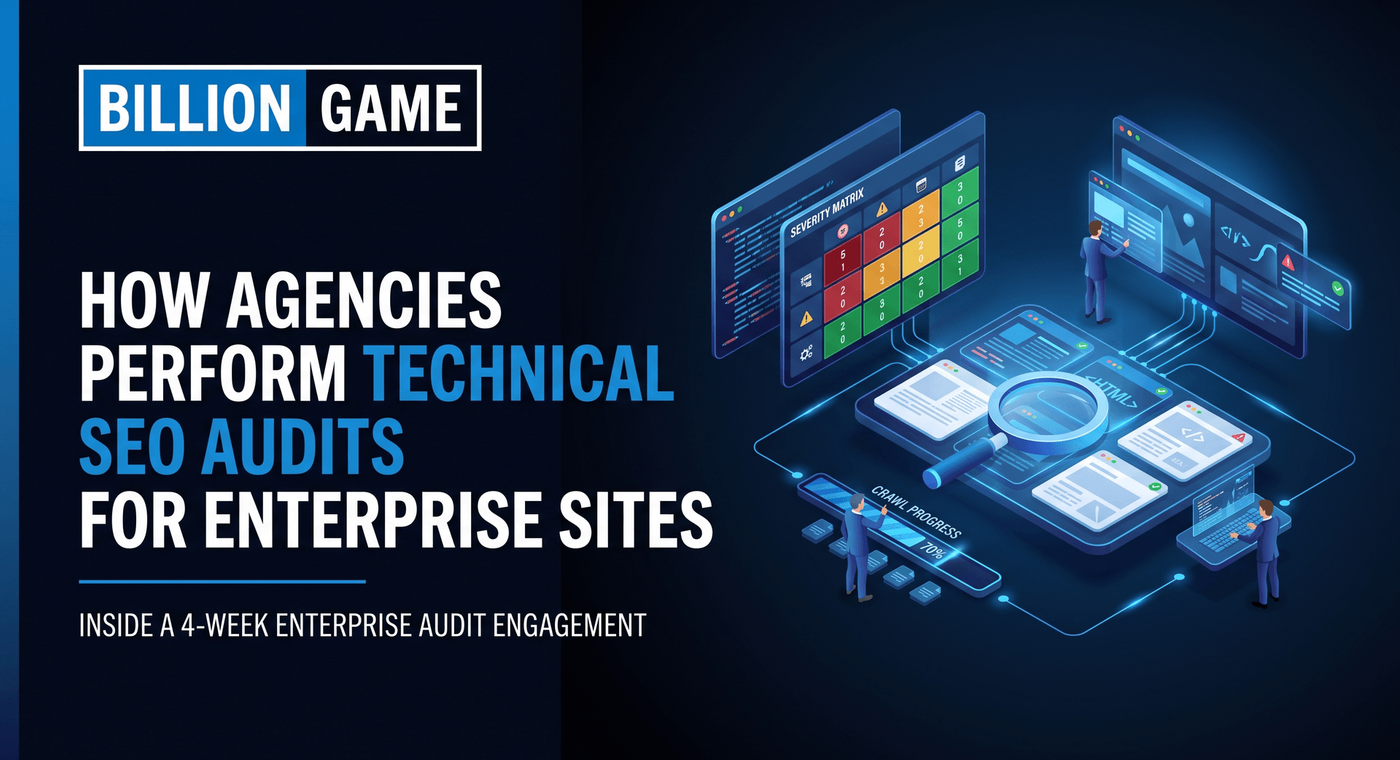
Agencies run enterprise technical SEO audits as a structured four to six week engagement, not a tool scan. A team of three to five specialists collects crawl, log file, Search Console and field performance data, analyses the site by page template rather than page by page, scores every finding on business impact against engineering effort, and delivers a prioritised roadmap written as tickets an engineering team can accept into a sprint. The report is the smallest part of the work. The scoring and the sequencing are what you are actually paying for.
Key Takeaways
- Enterprise audits are template audits. A standard audit reviews pages individually. An enterprise audit groups URLs by template and evaluates the group, because one fix on a product template can propagate across 400,000 URLs at once.
- Expect four to six weeks, not one. A standard technical audit runs one to two weeks from kickoff to deliverable. Enterprise and migration audits run two to four weeks longer because of redirect mapping, data volume and stakeholder coordination.
- Log files separate a real audit from a tool export. A crawler shows what exists on your site. Server logs show what Googlebot actually spent its budget on. Any agency that does not ask for log access is not auditing at enterprise level.
- Findings without impact scoring are useless. If the deliverable does not connect each technical issue to affected URL count, sessions and revenue, your team cannot sequence the work and nothing ships.
- The team is multi-role. A credible engagement has a technical lead, a data analyst, a crawl specialist and an account lead who speaks to engineering. One generalist running one tool is not an enterprise audit.
- You should receive tickets, not observations. Every high-priority finding needs a URL pattern, expected behaviour, acceptance criteria and a validation query.
What "Technical SEO Audit" Means at Enterprise Scale
At small scale a technical SEO audit is a list of broken things. At enterprise scale it is a diagnostic exercise in a system too large to inspect directly.
A 400 page site has 400 pages an auditor can actually look at. A 4 million page site cannot be reviewed that way by anyone, ever. So agencies stop auditing pages and start auditing the systems that generate pages: the CMS templates, the canonical logic, the faceted navigation rules, the rendering pipeline, the internal link modules and the sitemap generation.
That shift changes everything downstream. The unit of work is no longer "fix this page". It is "change this rule", and the change lands across every URL that template produces.
Google's own guidance draws the line in a similar place. Its large site crawl budget documentation names three groups that need active crawl management: sites with over 1 million unique pages where content changes moderately often, sites with over 10,000 unique pages where content changes daily, and sites with a large share of URLs sitting in "Discovered, currently not indexed". If your site matches any of those, a standard audit will not find your real problems.
The difference in practice
| Dimension | Standard technical audit | Enterprise technical audit |
|---|---|---|
| Unit of analysis | Individual page | Page template or URL pattern |
| Crawl approach | One full crawl | Segmented, sampled, scheduled crawls |
| Data sources | Crawler plus Search Console | Crawler, server logs, GSC API, BigQuery, CrUX, analytics |
| Team | One specialist | Three to five specialists |
| Timeline | One to two weeks | Four to six weeks |
| Output | Issue list | Scored, ticketed, sequenced roadmap |
| Main constraint | Finding the problems | Getting the fixes shipped |
Who Is Actually on the Audit Team
This is the part most articles skip, and it is the clearest signal of whether you are buying an enterprise audit or a rebadged small business one.
A credible engagement staffs four roles, sometimes held by three people:
Technical lead. Owns the diagnosis. Reads rendering behaviour, canonical logic and crawl patterns, and decides what actually matters. This is the most senior person on the engagement and the one whose judgment you are really buying.
Data analyst. Joins crawl data to log data to Search Console data to analytics. On a multi-million URL site this is a genuine data engineering job involving BigQuery or similar, not a spreadsheet exercise.
Crawl specialist. Configures and runs segmented crawls without taking down a production origin, and manages the rendering comparison between raw HTML and the rendered DOM.
Account or delivery lead. Translates findings into language a product manager and an engineering lead will act on, and runs the stakeholder sessions. Enterprise audits fail politically far more often than they fail technically, and this role exists to prevent that.
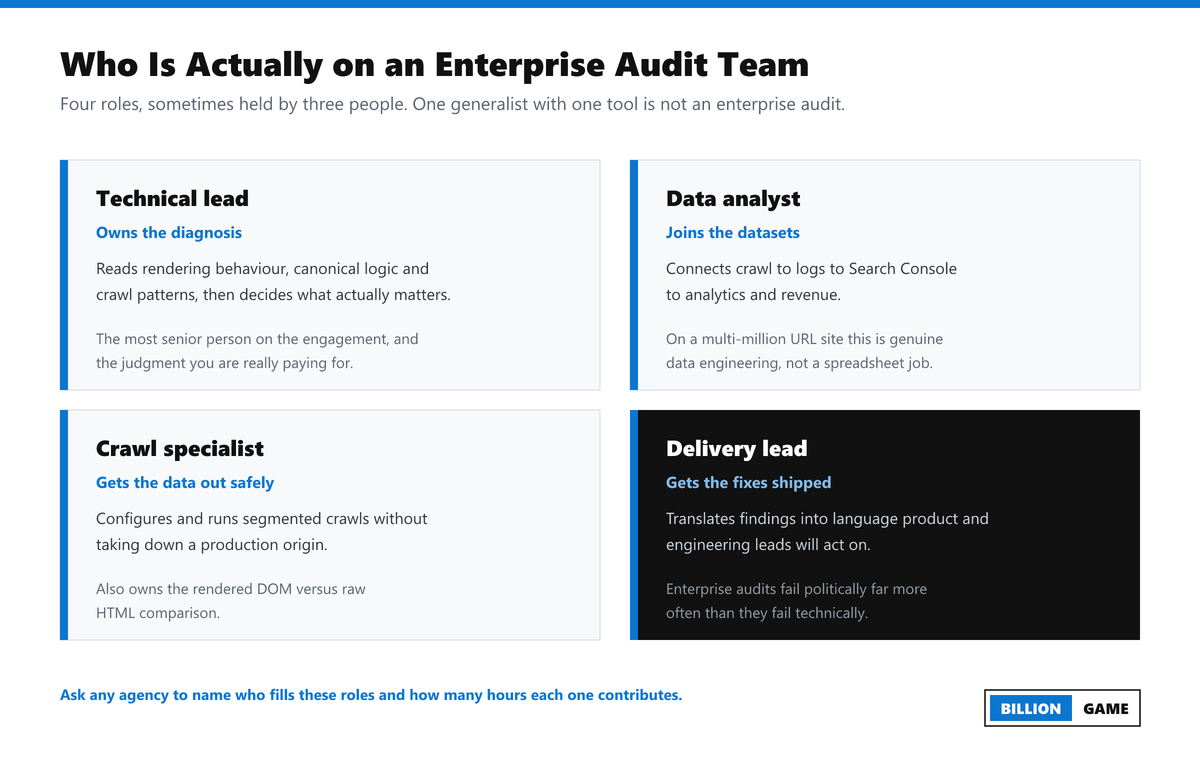
If an agency cannot tell you who fills these roles and how many hours each contributes, ask why.
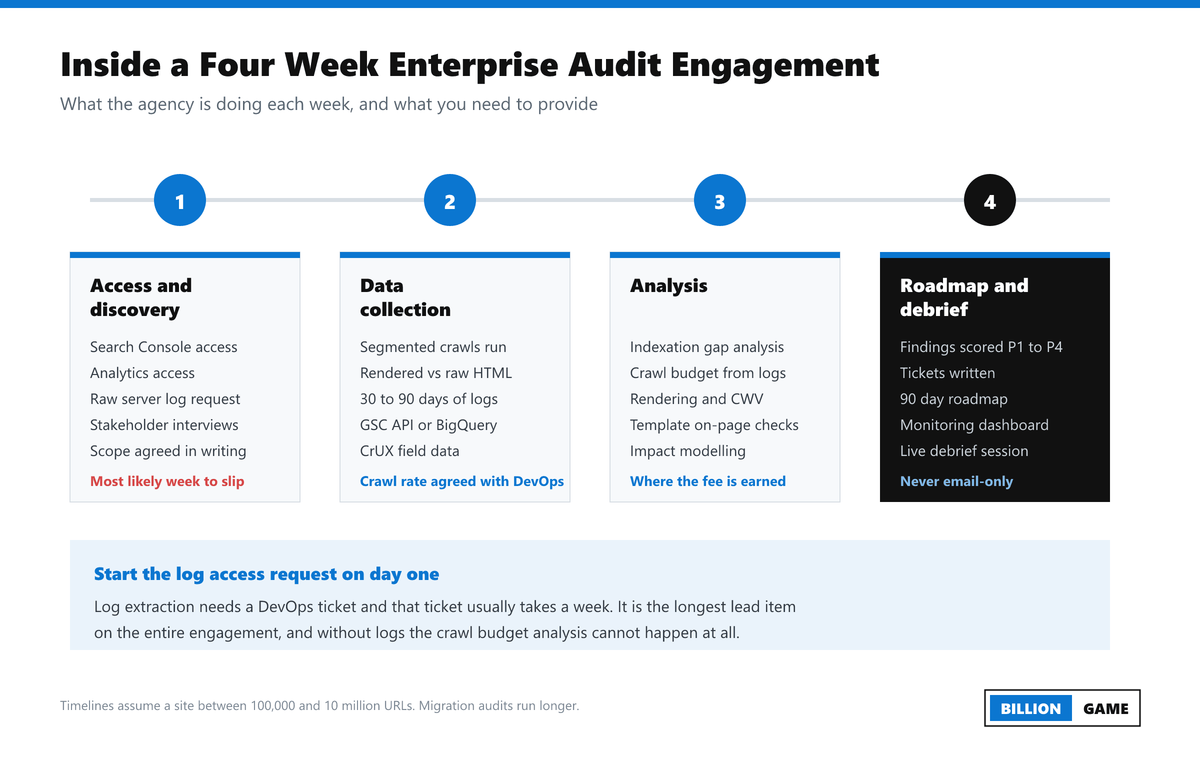
The Engagement, Week by Week
Timelines vary with site size and how fast the client's own teams respond, but the shape is consistent. If you want the same ground covered from the practitioner's side rather than the client's, our nine-phase enterprise SEO audit framework walks through the analysis itself step by step.
Week 1: Access, scoping and discovery
The audit starts with paperwork and permissions, and this is genuinely the phase most likely to slip.
The agency requests Search Console access at property and folder level, analytics access, and, critically, raw server access logs covering 30 to 90 days from the CDN or origin. Log extraction usually requires a DevOps ticket, and that ticket usually takes a week. Good agencies request it on day one for exactly this reason.
In parallel they run stakeholder interviews. Not to be polite, but because the technical problems are usually downstream of organisational ones. The auditor is trying to learn which team owns the CMS templates, when the last migration happened, what is already on the engineering roadmap, and what previous SEO recommendations were rejected and why.
They also agree scope in writing: which domains, subdomains and regions, which templates, and what data window.
Week 2: Data collection
Crawls run in this window, configured deliberately rather than pointed at the homepage and left alone.
A competent setup crawls as Googlebot smartphone, runs a JavaScript-rendered crawl and a parallel raw HTML crawl, respects robots.txt on the first pass and ignores it on a second, throttles to a rate agreed with DevOps, and connects to Search Console and analytics so every URL row carries clicks, impressions and sessions.
On sites above roughly 2 million URLs, agencies crawl by segment on a rotation rather than attempting one complete crawl, then validate the patterns against log and Search Console data across the full inventory.
Meanwhile the analyst is pulling Search Console data properly. The interface caps most reports at 1,000 rows, which is useless at this scale, so the work happens through the Search Analytics API, which returns up to 25,000 rows per request, or through the bulk data export into BigQuery. Where the bottleneck is diagnosing and re-validating errors inside the interface itself, that is a separate discipline covered by Google Search Console issue fixing.
Week 3: Analysis
This is where the fee is earned. The agency is running four analyses in parallel.
Indexation gap analysis. Comparing four URL sets: what the architecture exposes, what the sitemaps claim, what Googlebot actually requested according to logs, and what is indexed. Each gap has a distinct diagnosis. URLs in sitemaps that were never crawled are a discovery problem. URLs crawled but not indexed are a quality or duplication problem. URLs in "Discovered, currently not indexed" are a crawl budget or perceived value problem.
Log file and crawl budget analysis. Crawl distribution by segment, status codes over time, crawl frequency by click depth, orphan URLs receiving Googlebot hits, revenue URLs never crawled, and response time by template. Google is explicit that crawl budget is a function of your server's crawl capacity limit and its own crawl demand, so response time is an indexation lever, not just a UX metric.
Rendering and performance analysis. The delta between raw HTML and rendered DOM, which reveals what depends on client-side execution. Then Core Web Vitals by template group, weighted by sessions, against the published thresholds: LCP at 2.5 seconds or less, INP at 200 milliseconds or less, and CLS at 0.1 or less, all measured at the 75th percentile of real user loads. INP replaced First Input Delay on 12 March 2024 and is the metric most enterprise sites now fail, because it measures every interaction rather than only the first.
Template-level on-page validation. Sampling 20 to 50 URLs per template and checking title and heading patterns, canonical logic, meta robots in both HTML and HTTP headers, structured data validity, and hreflang reciprocity. Header-level directives matter here: an X-Robots-Tag noindex applied to a whole directory is a classic silent traffic killer that HTML-only tools miss entirely.
A few hard limits get checked along the way. Sitemaps must stay under 50,000 URLs and 50 MB uncompressed per file. Google ignores priority and changefreq entirely and only trusts lastmod when it is consistently accurate, so a CMS stamping today's date on every page nightly is training Google to ignore your sitemaps. And on page weight, Google's crawler documentation states a 15 MB default across its crawlers and fetchers, with a February 2026 clarification specifying 2 MB for supported file types and 64 MB for PDFs when crawling for Search.
Week 4: Scoring, roadmap and debrief
Findings get scored, sequenced, written up and presented. The presentation is not a formality. An audit that is emailed rather than walked through has a substantially lower chance of being implemented, which is why credible agencies insist on a debrief call.
How Findings Get Prioritised
Every finding is scored on two axes: business impact and engineering effort.
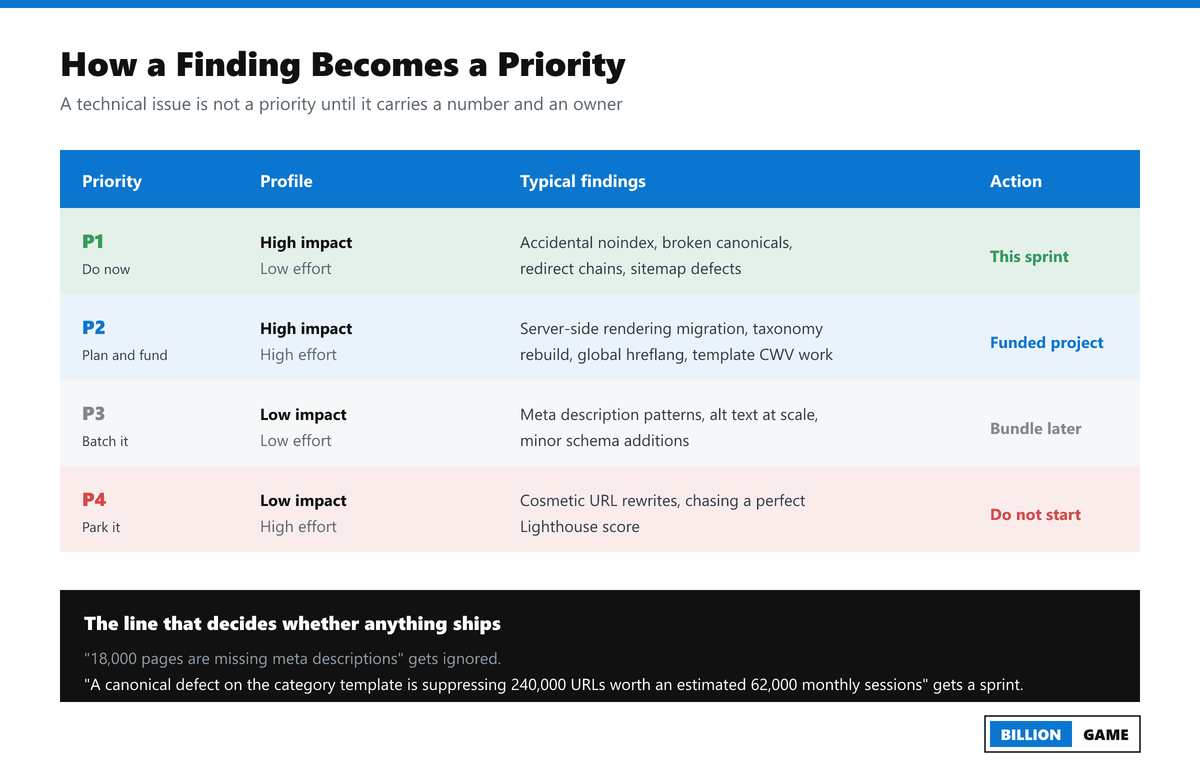
| Priority | Profile | Typical findings |
|---|---|---|
| P1, do now | High impact, low effort | Accidental noindex, broken canonicals, redirect chains, sitemap defects, restoring internal links to top URLs |
| P2, plan and fund | High impact, high effort | Server-side rendering migration, taxonomy rebuild, global hreflang system, template-level Core Web Vitals work |
| P3, batch it | Low impact, low effort | Meta description patterns, alt text at scale, minor schema additions |
| P4, park it | Low impact, high effort | Cosmetic URL rewrites, chasing a perfect Lighthouse score |
The impact model needs to be defensible rather than intuitive. A workable one: affected URLs multiplied by current impressions, multiplied by a realistic click-through uplift for the position change expected, multiplied by conversion rate and average order value. The assumptions get published alongside the number. A conservative model stakeholders trust beats an aggressive one they dismiss.
Without this layer, an audit is a list of complaints. "18,000 pages are missing meta descriptions" gets ignored. "A canonical defect on the category template is suppressing 240,000 URLs worth an estimated 62,000 monthly sessions" gets a sprint.
The Tool Stack
Agencies converge on a fairly standard stack, and the specific brands matter less than the categories being covered.
- Crawling: Screaming Frog in database storage mode, Sitebulb, Lumar, Botify, OnCrawl or JetOctopus. Desktop-only crawlers hit memory limits on multi-million URL sites.
- Log analysis: a dedicated log analyser, or raw logs processed in BigQuery for very large volumes.
- Search Console at scale: the Search Analytics API or the bulk data export to BigQuery.
- Performance: the Chrome UX Report for field data, PageSpeed Insights and Lighthouse for lab diagnosis.
- Analytics: GA4 or Adobe, mapped so sessions and revenue attribute to URL patterns rather than individual pages.
- Backlinks: Ahrefs, Semrush or Majestic for authority and internal link modelling.
- Reporting: Looker Studio or similar to join the datasets into something the client can keep watching after delivery.
The join between these datasets is the actual product. Any agency can export from one tool. The value is in connecting crawl data to log data to revenue data so the findings carry a number.
What You Actually Receive
A complete enterprise SEO audit deliverable has five components.
- Executive summary, one page. The commercial question, the answer, the three findings that matter, the estimated value and the ask. Written for someone who will not read page two.
- Prioritised findings register. Every issue with severity, affected URL pattern, affected URL count, business impact estimate, effort estimate and owner.
- Engineering tickets. The P1 and P2 items written as implementable specifications: current behaviour versus expected behaviour, acceptance criteria a QA engineer can test, and the validation query to run after release.
- A phased roadmap. Usually 90 days in detail and 12 months in outline, sequenced by dependency rather than by severity alone.
- A monitoring dashboard. Index coverage by segment, crawl requests by segment, click depth of revenue URLs and Core Web Vitals pass rate by template, so the client can verify that fixes worked.
Plus the debrief session, and ideally office hours during implementation. An audit handed over without implementation support has a poor track record of changing anything.
What Separates a Good Audit From an Expensive PDF
Ask these before you sign.
Do you need our server logs? If the answer is no, it is not an enterprise audit. Logs are the only source that shows real crawler behaviour.
How will you handle a site with millions of URLs? The correct answer involves segmentation and sampling. "We will crawl the whole site" on a 5 million URL site is either untrue or reckless.
How do you estimate business impact? They should have a model and be willing to show it.
Who is on the team and what are their hours? Named roles, not "our expert team".
What does the deliverable look like? Ask to see a redacted sample. Most agencies will not have one, which tells you something.
What happens after delivery? An audit with no implementation support, no validation and no follow-up is a document, not an outcome.
The red flags run the other way too: a fixed-price audit quoted without seeing the site, a deliverable that is a tool export with a logo on it, severity ratings with no business context, and any agency that promises specific ranking outcomes from an audit.
What It Costs and How Long It Takes
Enterprise technical audits are priced on scope and site complexity rather than a menu rate. The variables that move the number are URL count, number of templates, number of regions and languages, whether log analysis is included, and whether the engagement includes implementation support or ends at the handover.
Timelines are more predictable. Four to six weeks is standard for a site between 100,000 and 10 million URLs. Migration audits sit at the longer end because redirect mapping and pre-launch parity checks add genuine work. Anything quoted at under two weeks for an enterprise site is either narrow in scope or skipping the log analysis.
The realistic value question is not what the audit costs. It is what the implementation costs and what it returns, because an audit changes nothing on its own.
How to Prepare Before the Engagement Starts
Clients who do these four things get a materially better audit, because the team spends its time analysing rather than chasing.
- Start the log access request now. It is the longest lead item on the project.
- Map your own stakeholders. Know who owns CMS templates, canonical logic, hreflang and robots directives before you are asked.
- Write down the commercial question. "Organic revenue fell 22% over three quarters and we cannot explain it" produces a far better audit than "we want an SEO audit".
- Collect your history. Past migrations, previous audits, rejected recommendations and known technical debt. Auditors waste days rediscovering things the client already knew.
Frequently Asked Questions
How long does an enterprise technical SEO audit take?
Four to six weeks for a site between 100,000 and 10 million URLs. A standard technical audit takes one to two weeks, and enterprise or migration audits add two to four weeks for redirect mapping, data volume and stakeholder coordination. Log file access is usually the longest dependency.
What is the difference between a technical SEO audit and an enterprise technical SEO audit?
Scope and unit of analysis. A technical audit reviews pages for crawlability, indexability, performance and rendering. An enterprise technical audit analyses page templates and CMS rules instead of individual pages, joins crawl data with server logs and Search Console data, and adds the impact scoring and governance needed to get fixes shipped across multiple teams.
Why do agencies need server log files?
A crawler shows what exists on your site. Server logs show what Googlebot actually requested, how often, and what it ignored. That gap is where most enterprise crawl budget problems live, and no other data source reveals it. An audit without logs is diagnosing crawl behaviour by inference.
How do agencies audit a site with millions of URLs?
By segment and by sample. They crawl segments on a rotation rather than attempting one complete crawl, take a statistically meaningful sample per template, typically 5,000 to 20,000 URLs, and validate the patterns against log and Search Console data across the full inventory. Pattern accuracy matters more than total coverage.
What deliverables should an enterprise SEO audit include?
A one-page executive summary, a prioritised findings register with severity and business impact, engineering tickets with acceptance criteria for the high-priority items, a phased roadmap, a monitoring dashboard, and a live debrief session. Findings without tickets rarely get implemented.
How much does an enterprise technical SEO audit cost?
It is scoped rather than listed, driven by URL count, template count, regions and languages, whether log analysis is included, and whether implementation support is in scope. Be cautious of a fixed price quoted before anyone has looked at the site.
Can we run an enterprise technical audit in-house?
Yes, if you have log access, a scalable crawler, an analyst comfortable in SQL or BigQuery, and enough internal influence to book engineering time. Teams usually bring in an external agency for independence when funding a large project rather than for lack of skill.
How often should an enterprise site be audited?
A full technical audit annually, a focused health check quarterly, and continuous monitoring in between. Add an unscheduled audit after any platform migration, design system change, CDN change, or unexplained double-digit drop in non-brand organic sessions.
Does an audit include implementation?
Often not, and you should confirm before signing. Many agencies deliver the audit and stop. The engagements that actually move revenue include implementation support, validation after each release, and a re-test cycle.
Will an audit help with AI search visibility?
Indirectly and significantly. With 68.01% of US Google searches ending without a click in early 2026 according to SparkToro's analysis of Similarweb clickstream data, citation in AI answers increasingly matters, and it depends on the same foundations an audit fixes: crawler access, clean extractable structure, and consistent entity signals. Ask whether the audit covers AI crawler access explicitly, because many still do not.
What is an enterprise technical SEO audit?
An enterprise technical SEO audit examines the systems that generate pages rather than the pages themselves, covering CMS templates, canonical logic, faceted navigation, rendering and sitemap generation. It joins crawl data with server logs and Search Console data, then scores each finding on business impact against engineering effort.
How much does an enterprise technical audit cost?
Enterprise audits are scoped rather than listed, driven by URL count, template count, regions and languages, whether log analysis is included, and whether implementation support is in scope. Be cautious of a fixed price quoted before anyone has looked at the site.
What does an enterprise SEO agency audit include?
A one-page executive summary, a prioritised findings register with severity and business impact, engineering tickets carrying acceptance criteria, a phased roadmap, a monitoring dashboard and a live debrief. Findings without tickets rarely get implemented.
The Bottom Line
The mechanics of an enterprise technical SEO audit are not secret. Crawl, log, join, analyse by template, score, sequence, present. What separates the engagements that change revenue from the ones that produce a PDF is whether the agency scores findings against business impact, writes them as tickets an engineer can accept, and stays involved while they ship.
If you are evaluating agencies for enterprise SEO, judge them on the deliverable and the follow-through rather than the checklist. Every agency checks canonicals. Very few hand your engineering team something they can put straight into a sprint.
Sources: Google Search Central documentation on managing crawl budget for large sites, sitemaps, and Googlebot file size limits (February 2026 clarification); web.dev Core Web Vitals documentation, Chrome team; Google Search Console Search Analytics API documentation; SparkToro analysis of Similarweb clickstream data, January to April 2026.
Share
Ready to Hire an AI SEO Expert?
Book a free 30 minute AI Visibility Audit. We analyze your search visibility across Google, ChatGPT, Perplexity AI and AI Overviews.
About the author

Ganesh Shanmugam
Ganesh Shanmugam is an SEO and AEO consultant based in Chennai, India, and the founder of Billion Game — a boutique agency serving clients across the US, UK, Australia, Canada, and Ireland. He previously held SEO roles at 7 Eagles and Digital Scholar before going independent, and brings 4+ years of hands-on experience
AI SEO insights in your inbox
For growth-stage brands: organic traffic, AI citations, and strategy notes. No spam—unsubscribe anytime.
By subscribing you agree to our Privacy Policy.