SEO BLOG
Do I Need a GEO Agency? An Honest Answer for 2026
 Ganesh Shanmugam6 min read
Wondering if you need a GEO agency? Learn what generative engine optimisation really involves, what Google says you can ignore, and when specialist help pays off.
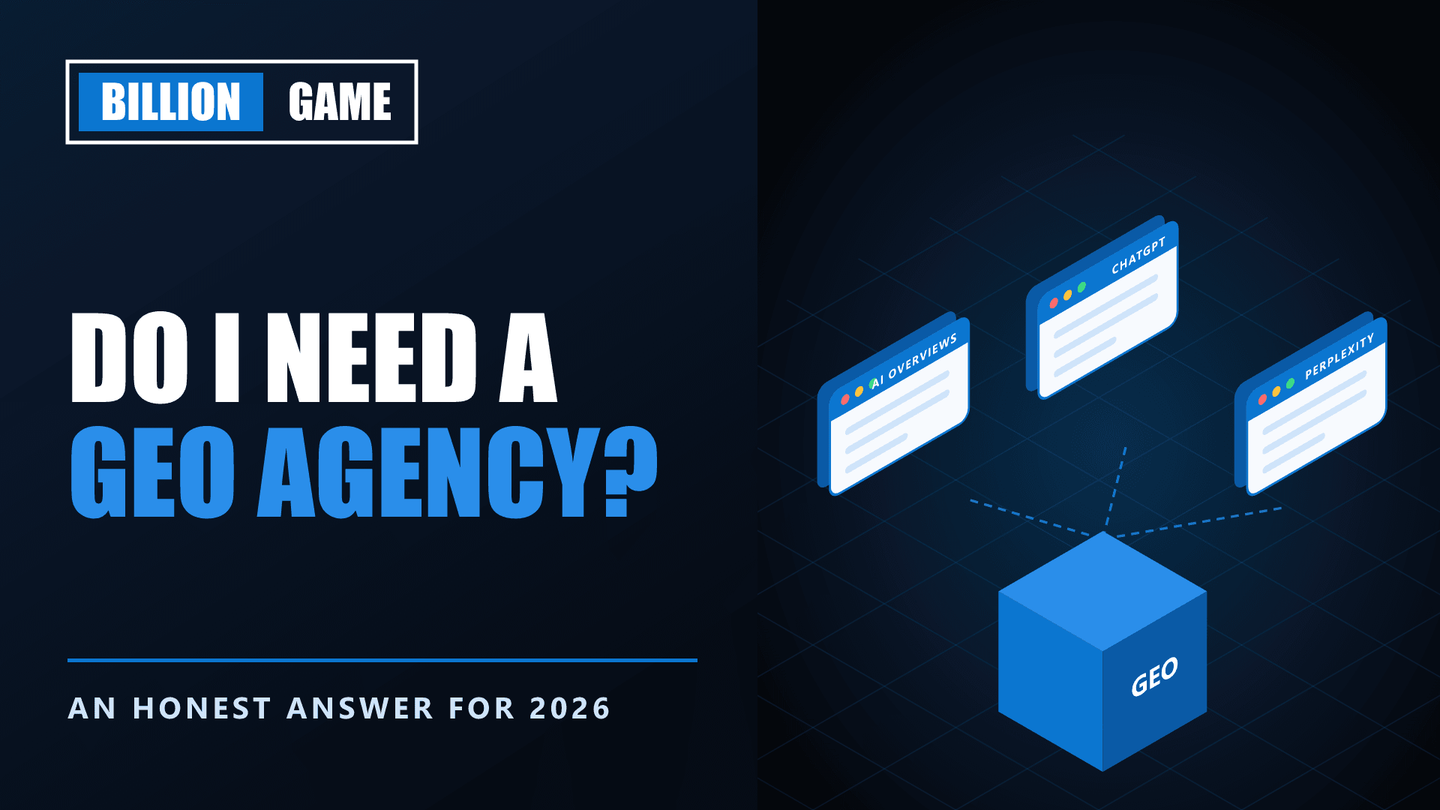
A new kind of agency has appeared almost overnight. Generative engine optimisation, or GEO, promises to get your brand into ChatGPT, Perplexity and Google's AI answers. Some pitches make it sound as if traditional SEO is finished.
So founders and marketers are asking a reasonable question. On Reddit, one thread simply asks whether anyone has hired a GEO agency for their SaaS and seen actual results. If you are asking "do I need a GEO agency?", you deserve an honest answer rather than a sales pitch.
This guide gives you one. It covers what GEO really involves, what Google itself says you can ignore, where specialist knowledge genuinely helps, and how to tell a credible GEO provider from one selling hacks.
Key Takeaways
- For Google, GEO is mostly good SEO. Google says its AI features are rooted in its core ranking and quality systems.
- Google says many "hacks" are unnecessary. Its July 2026 guide says you can ignore llms.txt files, content chunking and special AI markup.
- Other assistants add real specifics. ChatGPT and Perplexity run their own crawlers, which firewalls and CDNs often block.
- You need GEO expertise, not necessarily a separate agency. A strong SEO agency should already cover AI search.
- Specialist help pays off in some situations. For example, when buyers research in AI tools, or when AI answers get your brand wrong.
- Vet GEO providers carefully. Google now suggests checking whether AI search advice matches its official guidance.
Do I Need a GEO Agency?
Quick answer: Most businesses do not need a separate GEO agency. They need an SEO partner that understands AI search. For Google's AI Overviews and AI Mode, Google says the same SEO best practices apply. However, ChatGPT and Perplexity use their own crawlers and sources, which adds technical and reputation work that some SEO agencies overlook. Hire GEO specialists if your buyers research in AI assistants, your SEO basics are already strong, or AI answers misrepresent your brand.
The rest of this guide explains the reasoning, so you can judge any GEO pitch for yourself.
What GEO Actually Means
GEO describes the work of making a brand visible and accurately represented in answers generated by AI systems. AEO, or answer engine optimisation, is a closely related term. The goal of both is to be the source an AI assistant uses, quotes or recommends.
That is a real goal. The question is how different the work really is from SEO.
What Google Says About GEO
Google addressed this directly in its guide to optimising for generative AI features, last updated in July 2026. Its position is clear: SEO best practices remain relevant because its generative AI features are rooted in its core Search ranking and quality systems.
Google also lists things you can ignore for Google Search:
- llms.txt files and other "special" markup, which Google Search does not use
- "Chunking" content into tiny pieces for AI
- Rewriting content just for AI systems
- Seeking inauthentic mentions across the web
- Overfocusing on structured data, which is not required for its AI features
Independent data points the same way on llms.txt. Ahrefs analysed 137,210 domains and found that 97% of llms.txt files were never read by the crawlers they were written for.
Google's hiring guidance, updated in June 2026, now includes a question aimed squarely at GEO providers. If an SEO offers advice on optimising for AI experiences, Google suggests asking whether that advice aligns with its official guidance on generative AI features.
Where GEO Adds Something Real
Google is only one part of the picture. Other assistants work differently, and that creates genuine specialist work.
Different crawlers. ChatGPT's search relies on OpenAI's OAI-SearchBot, and Perplexity uses PerplexityBot. Many sites block them without knowing it, through robots.txt rules, firewalls or CDN defaults. Cloudflare, for example, changed its AI crawler defaults for new domains in 2025 and again on 15 September 2026.
JavaScript rendering. Many AI crawlers do not execute JavaScript, so sites built as single-page applications can look empty to them, even when Google indexes them fine.
Reputation beyond your site. Assistants often draw on reviews, directories and community discussions. Building genuine presence there sits closer to PR than to on-page SEO.
Measurement. Tracking visibility across several assistants, with answers that vary each time, needs a deliberate method. Search Console's Generative AI performance report covers Google, while other platforms need structured prompt testing.
Do You Need Specialist Help? A Quick Guide
| Your situation | What to do |
|---|---|
| Weak SEO basics, few indexed pages, little content | Fix SEO first. AI visibility builds on it. |
| Strong Google rankings, but absent from AI answers | GEO expertise will likely help. |
| Buyers research in ChatGPT or Perplexity before contacting you | GEO expertise is worth prioritising. |
| AI assistants describe your brand inaccurately | Specialist help is worth it. |
| Local business with a small market | A good SEO partner covering AI basics is enough. |
| Site built as a JavaScript single-page application | Get a technical review for AI crawler access. |
The pattern is simple. GEO rewards businesses that already have solid foundations. If your SEO basics are weak, GEO spending will not compensate for them.
Red Flags in GEO Pitches
Because the field is new, some offers are more marketing than method. Be cautious of:
- Selling llms.txt files as a core service, given what Google says and how rarely crawlers read them
- Guaranteed placement in ChatGPT answers, which no one can control
- Planting fake mentions on Reddit, forums or review sites, which Google warns against and communities quickly remove
- Rewriting your whole site into "AI-ready chunks," which Google says is unnecessary
- No measurement method, or reports built on a single screenshot of one answer
Many of these overlap with classic warning signs. Our list of SEO agency red flags covers the rest.
What Credible GEO Work Includes
A trustworthy provider, whether a GEO specialist or an SEO agency with AI expertise, should cover:
- Crawler access, across robots.txt, firewalls and CDNs, for Google, OpenAI and Perplexity
- Rendering, making sure key content exists in plain HTML
- Content quality, creating the unique, non-commodity content Google's guide emphasises
- Entity consistency, so your brand details match everywhere they appear
- Earned reputation, through genuine PR and community presence
- Measurement, combining Search Console data with structured prompt testing
If you want to see where you stand before deciding, our guide on how to check if ChatGPT knows your brand gives you a free method. If you are missing entirely, start with why your website is not showing in ChatGPT.
How We Approach It
At Billion Game, we treat GEO as an extension of SEO rather than a replacement for it. Our GEO services start with the foundations Google describes, then add the crawler access, reputation and measurement work that other assistants require. If you would like a benchmark first, our AI citation audit shows how you appear across the major assistants.
Frequently Asked Questions
Has anyone hired a GEO agency and seen actual results?
Results depend heavily on the starting point. Businesses with strong SEO foundations tend to see the clearest gains, especially when the work fixes crawler access and builds genuine third-party reputation.
Is SEO turning into AEO and GEO?
It is expanding rather than being replaced. Google says its AI features rely on its core ranking systems, so SEO remains the foundation. AEO and GEO add work for assistants that use their own crawlers and sources.
What is the difference between GEO and SEO?
SEO aims to rank pages in search results. GEO aims to have your brand used and cited in AI-generated answers. For Google, the practices largely overlap, while other assistants add crawler, reputation and measurement work.
Are GEO agencies worth it for local businesses?
Usually not as a separate service. Most local businesses benefit more from strong local SEO and a well-maintained Google Business Profile, which Google says also helps visibility in AI responses.
How do I choose a GEO agency?
Ask whether its advice aligns with Google's official guidance, how it measures visibility across assistants, and how it builds reputation. Avoid providers that guarantee placements or plant fake mentions.
Final Thoughts
GEO is a real discipline, but it is not a replacement for SEO. For Google, it largely is SEO done well. For ChatGPT and Perplexity, it adds genuine technical and reputation work that many agencies still miss.
So the honest answer to "do I need a GEO agency?" is this: you need GEO expertise, and the best place to find it is usually an SEO partner that already understands AI search.
Share
Ready to Hire an AI SEO Expert?
Book a free 30 minute AI Visibility Audit. We analyze your search visibility across Google, ChatGPT, Perplexity AI and AI Overviews.
About the author

Ganesh Shanmugam
Ganesh Shanmugam is an SEO and AEO consultant based in Chennai, India, and the founder of Billion Game — a boutique agency serving clients across the US, UK, Australia, Canada, and Ireland. He previously held SEO roles at 7 Eagles and Digital Scholar before going independent, and brings 4+ years of hands-on experience
AI SEO insights in your inbox
For growth-stage brands: organic traffic, AI citations, and strategy notes. No spam—unsubscribe anytime.
By subscribing you agree to our Privacy Policy.