INDEXING
How to Get Google to Index Your BigCommerce Website (2026 Guide)
 Ganesh Shanmugam6 min read
Learn how to get Google to index your BigCommerce website. Discover why sitemap submissions fail, how to control faceted URLs, and the checks that fix indexing.
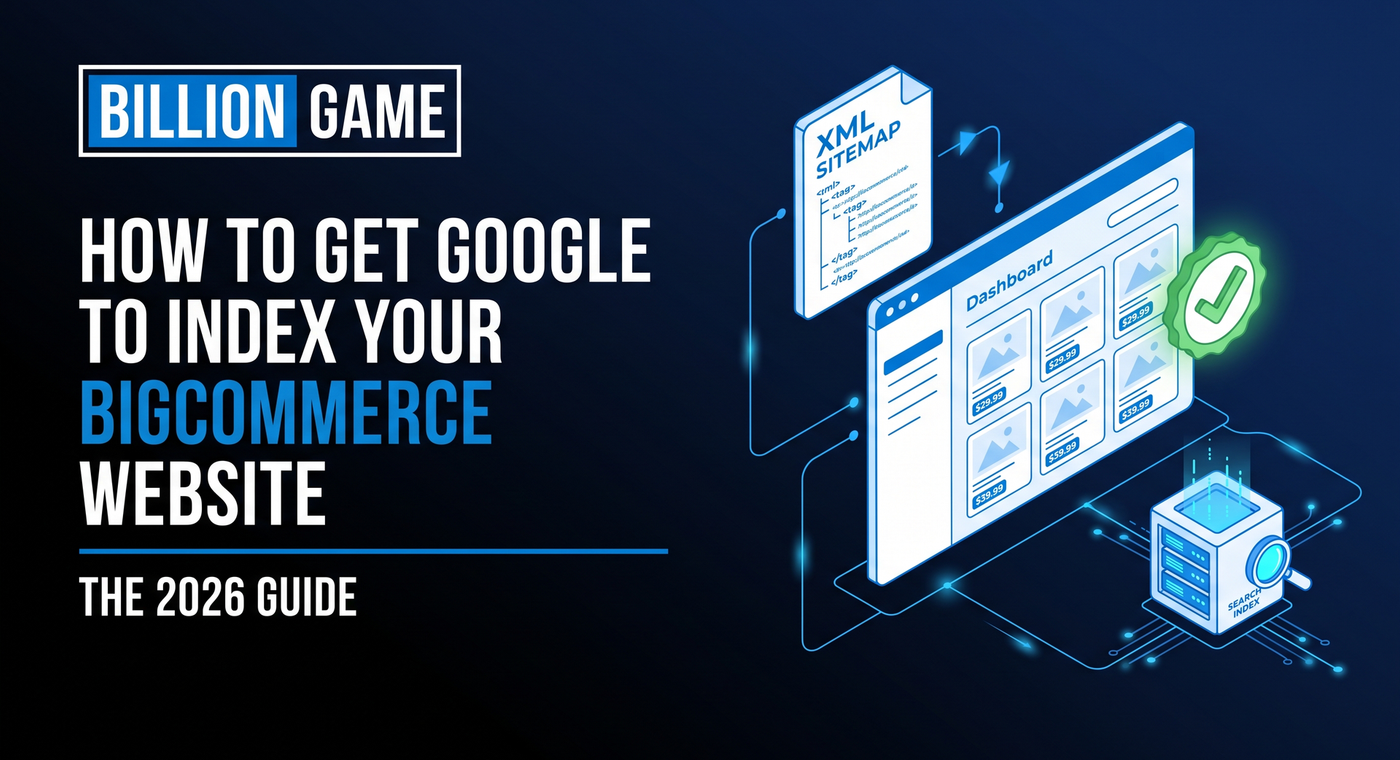
You submitted your sitemap and Google returned an error. Then you tried again, and it failed the same way.
That single problem accounts for a surprising share of the trouble people hit when trying to get Google to index their BigCommerce website, and the cause is almost comically simple. BigCommerce does not serve its sitemap where nearly everyone expects it.
This guide covers that fix first, then the store settings that block indexing, how to stop faceted navigation flooding your crawl budget, and how to confirm what Google actually did with your product pages.
Key Takeaways
- Your sitemap is not at /sitemap.xml. BigCommerce serves it at /xmlsitemap.php, which is why so many submissions fail.
- The sitemap updates itself. BigCommerce generates it for products, categories and content pages, and refreshes it as your catalogue changes.
- Canonicals are handled for you. Product pages carry canonical tags automatically, and filtered URLs point back to the base category by default.
- Faceted navigation is still the main risk. Every filter combination can spawn a URL, so decide which deserve indexing and block the rest.
- You can edit robots.txt directly, which most hosted platforms do not allow.
- Preview and holding pages cannot be indexed. The storefront has to be publicly live first.
How to Get Google to Index Your BigCommerce Website
Five steps handle nearly every case.
- Take the store out of preview so it is publicly reachable.
- Submit the sitemap at /xmlsitemap.php in Google Search Console.
- Bring faceted and filtered URLs under control in robots.txt.
- Request indexing on your priority category and product pages.
- Verify what Google received using URL Inspection.
Step 1: Confirm the Storefront Is Publicly Live
Google cannot index a store it cannot open.
BigCommerce stores sit behind a preview or holding page until you launch them, and stores under construction stay invisible no matter how complete the catalogue is. Open your storefront in a private browser window where you are not signed in. If you meet a password prompt or a coming-soon page, that is your answer.
Check the store is on your custom domain too, rather than the temporary BigCommerce URL. Launching later on a different domain means migrating signals you could have earned from the start.
Step 2: Submit the Sitemap at the Right URL
Here is the detail that trips up most people.
BigCommerce serves its XML sitemap at /xmlsitemap.php, not /sitemap.xml. Submit the usual path and Search Console reports a fetch error, which looks like a broken sitemap rather than a wrong address.
So do this instead:
- Open yourstore.com/xmlsitemap.php in a browser and confirm it loads.
- In Google Search Console, go to Indexing, then Sitemaps.
- Enter xmlsitemap.php and submit.
- Wait for the status to read Success rather than an error.
The good news is that BigCommerce maintains this file for you. It covers products, categories and content pages, and updates as items are added or removed, so you rarely need to think about it again once submitted.
Add a reference in robots.txt as well, so crawlers find it without relying on Search Console:
Sitemap: https://yourstore.com/xmlsitemap.phpStep 3: Control Faceted Navigation Before It Eats Your Crawl Budget
BigCommerce generates a unique URL for every filter combination, which is convenient for shoppers and dangerous for crawl efficiency.
A single category with filters for size, colour, price and material can spawn dozens of near-identical URLs. Multiply that across a catalogue and Googlebot spends its time on filter permutations instead of the product pages that make you money.
The platform does help here. Filtered URLs canonicalise back to the base category page by default, and product pages carry canonical tags automatically. That prevents the worst of the duplicate content dilution.
Crawl waste remains a separate problem though, because Google still has to fetch a URL before reading its canonical. So decide filter by filter which combinations genuinely deserve an indexable URL, then disallow the rest in robots.txt.
Since BigCommerce lets you edit robots.txt directly, which many hosted platforms do not, you can act on that decision immediately. If your store is large enough that this analysis needs doing properly, our ecommerce SEO work covers exactly this.
Step 4: Request Indexing for Priority Pages
Sitemaps help Google discover URLs. They do not prioritise them.
Use URL Inspection in Search Console on the pages that matter most, usually your top categories and best-selling products, then click Request Indexing. Treat this as a nudge rather than a command, because Google still decides on merit.
Do not attempt this for a whole catalogue. Quotas are small, and bulk submission through the interface is not what it is designed for.
Step 5: Check What Google Actually Received
Inspect a live product URL and select View Crawled Page. Read the HTML that comes back.
Look for three things: your product title and description present in the source, the canonical pointing where you expect, and no stray noindex directive. If all three check out, rendering is fine and any remaining issue is about content quality or crawl priority.
To work out roughly when a page entered the index, our guide on how to check when a page was indexed by Google explains the closest available methods.
Why BigCommerce Pages Still Do Not Get Indexed
When the setup is right and pages still fail to appear, these are the usual causes.
- Thin product descriptions. Manufacturer copy reused across many stores gives Google little reason to store your version. Rewrite descriptions on your priority products first.
- Out of stock products. Long-term unavailable items often get dropped. Decide whether to keep, redirect or remove them.
- Duplicate titles across variants. Several products sharing one title is a common cause of exclusion.
- Crawl budget lost to filters. Covered above, and the most common issue on larger catalogues.
- Orphan products. Items reachable only through search or filters get discovered slowly. Link them from category pages and related product modules.
- Pages sitting at Crawled, currently not indexed. That is a quality verdict rather than a technical fault, and our guide on fixing Crawled, currently not indexed explains what to do.
Should pages still refuse to index after all of that, our Google indexing services exist for exactly that situation.
Getting BigCommerce Products Into AI Answers
Being in Google's index is now the floor rather than the finish line, because a growing share of product research happens inside AI assistants that summarise rather than link.
Two things matter here. First, check your robots.txt is not blocking AI crawlers such as GPTBot, ClaudeBot, PerplexityBot and Google-Extended. Since BigCommerce gives you direct robots.txt access, this is quick to confirm and quick to fix.
Second, structure product information so it can be extracted. Clear specifications in tables, direct answers to common questions, and consistent brand naming all help. That work sits under AEO services, and it applies to product pages as much as to articles.
Frequently Asked Questions
Where is the BigCommerce sitemap?
At `yourstore.com/xmlsitemap.php`. BigCommerce does not use `/sitemap.xml`, which is why submissions to that address fail in Search Console.
Does BigCommerce create a sitemap automatically?
Yes. It generates sitemaps for products, categories and content pages, and updates them as your catalogue changes, so you do not need a plugin or manual regeneration.
Why is my BigCommerce store not showing on Google?
The most common causes are a storefront still in preview mode, a sitemap submitted to the wrong URL, thin product descriptions, or simply not enough time having passed since launch.
How long does BigCommerce take to get indexed?
Usually days to a few weeks for a new store. Established stores publishing regularly tend to see new products indexed faster, and submitting the sitemap speeds discovery without guaranteeing inclusion.
Can I edit robots.txt on BigCommerce?
Yes. BigCommerce allows direct robots.txt editing, which is unusual among hosted platforms and useful for controlling filter and faceted URLs.
Do I need to worry about duplicate URLs from filters?
Less than on some platforms, because filtered URLs canonicalise back to the base category by default. Crawl waste is still worth managing, since Google must fetch a URL before it can read the canonical.
Should I request indexing for every product?
No. Quotas are small and it is not designed for bulk use. Request indexing for priority categories and bestsellers, then let the sitemap handle the rest.
Can BigCommerce websites be found on Google?
Yes. BigCommerce generates XML sitemaps automatically and applies canonical tags to product pages, so stores can be found on Google like any other site. Problems usually come from a storefront still in preview mode or a sitemap submitted to the wrong address.
Why does my BigCommerce store not show up in Google search?
The most common causes are a store still behind the preview or holding page, a sitemap submitted at /sitemap.xml instead of /xmlsitemap.php, thin manufacturer product descriptions, or simply not enough time since launch.
How long does BigCommerce take to show on Google?
Usually days to a few weeks for a new store. Submitting the sitemap at the correct address speeds up discovery, and established stores publishing regularly see new products indexed faster.
Final Thoughts
Most BigCommerce indexing problems come down to two things: a store that is not yet publicly live, and a sitemap submitted to an address BigCommerce does not use.
Fix those, bring filtered URLs under control, then check what Google actually received rather than assuming. That covers the overwhelming majority of cases.
If products still refuse to appear once you have worked through all of that, the problem has usually shifted from technical to editorial, and product copy is the first place to look. Should you want help getting Google to index your BigCommerce website properly, our BigCommerce development and ecommerce SEO teams handle the whole setup.
Share
Ready to Hire an AI SEO Expert?
Book a free 30 minute AI Visibility Audit. We analyze your search visibility across Google, ChatGPT, Perplexity AI and AI Overviews.
About the author

Ganesh Shanmugam
Ganesh Shanmugam is an SEO and AEO consultant based in Chennai, India, and the founder of Billion Game — a boutique agency serving clients across the US, UK, Australia, Canada, and Ireland. He previously held SEO roles at 7 Eagles and Digital Scholar before going independent, and brings 4+ years of hands-on experience
AI SEO insights in your inbox
For growth-stage brands: organic traffic, AI citations, and strategy notes. No spam—unsubscribe anytime.
By subscribing you agree to our Privacy Policy.