INDEXING
How to Fix 'Discovered – Currently Not Indexed' in GSC (2026 Guide)
 Ganesh Shanmugam11 min read
Discovered – currently not indexed' means Google found your URL but decided not to crawl it yet. This guide breaks down the real causes (crawl budget, content quality, internal links, server speed) and gives you a step-by-step fix to move pages from discovered to indexed.
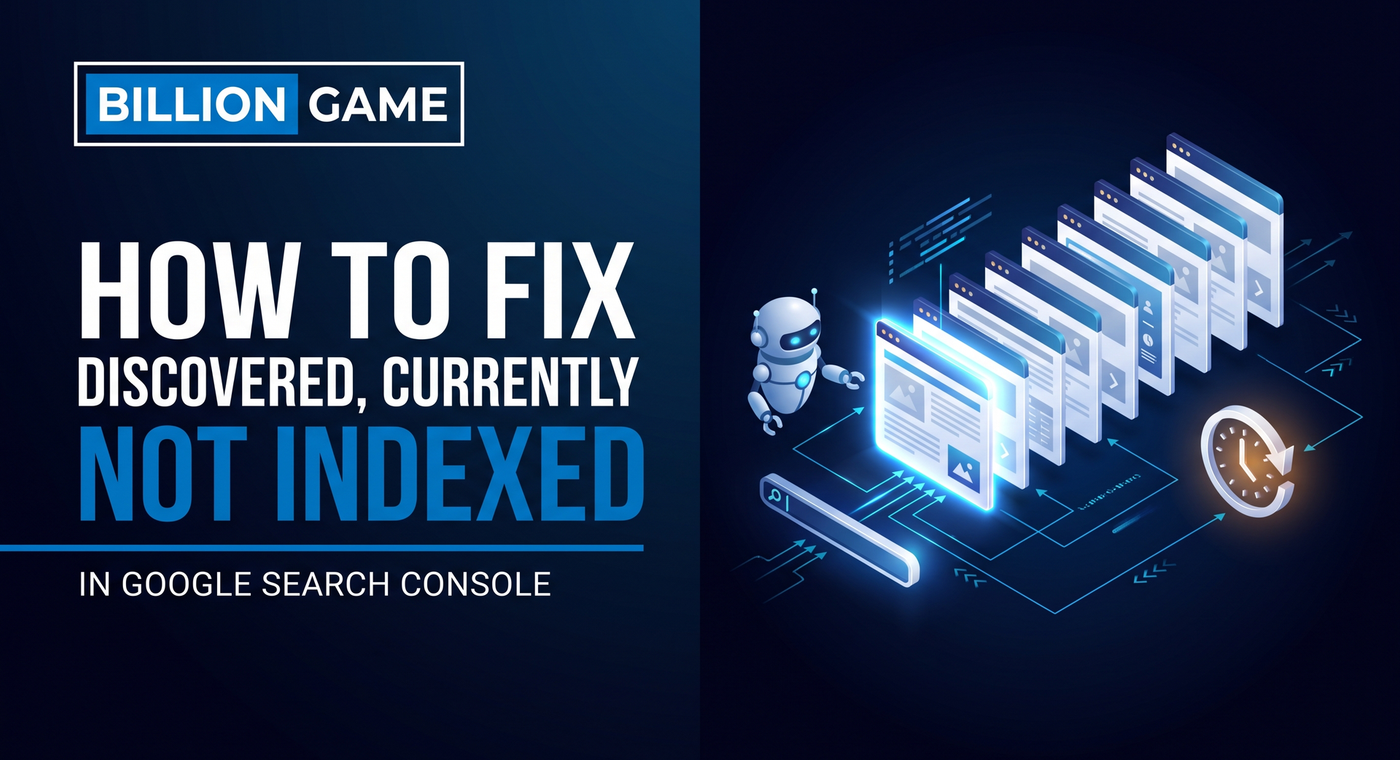
This is one of the most common and most frustrating statuses in SEO. Your page is not broken. There is no penalty. Google simply decided your URL was not worth crawling right now. The web is effectively infinite, and Googlebot's resources are finite, so Google rations crawling and skips URLs it predicts will be low value or technically expensive to fetch.
It matters because an unindexed page earns zero traffic, zero rankings, and zero revenue. Google's own John Mueller has said it is normal for roughly 20% of a site to go unindexed, and an Ahrefs study of around 14 billion pages found that 96.55% of pages get no organic traffic from Google at all. Getting out of "Discovered – currently not indexed" is the first gate you have to clear.
Key Takeaways
- "Discovered – currently not indexed" = Google found the URL but has not crawled it yet; it cannot rank until it is indexed.
- The biggest levers are internal linking, content quality, server speed, and crawl budget (in that rough order of frequency).
- Distinguish it from "Crawled – currently not indexed," which is almost always a content quality problem.
- Fix the fundamentals first, then push URLs into the crawl queue with GSC and a bulk tool like SEO Labs Indexer.
- For site-wide or recurring indexing problems, a Google Indexing Expert or Google Search Console Expert will find the root cause faster.
What "Discovered – Currently Not Indexed" Actually Means
To fix this status, you have to understand where it sits in Google's indexing pipeline. There are four stages:
- Discovery – Google finds a link to your URL via your sitemap, an internal link, or a backlink.
- Queueing – the URL is added to Googlebot's crawl queue.
- Deferral – when the scheduler reaches your URL, it decides to skip it.
- Rescheduling – the URL stays in Google's database to be crawled at some unspecified later date.
"Discovered – currently not indexed" means you are stuck at stage 3. Google knows the page exists but has chosen not to spend resources fetching it. You will find it in GSC under Indexing → Pages → "Why pages aren't indexed." A telltale sign: these URLs usually show no last crawl date in the URL Inspection Tool.
Quick answer: "Discovered – currently not indexed" means Google has found your URL (through your sitemap, an internal link, or a backlink) but has not crawled it yet, so it is not in the index and cannot rank. It is usually caused by limited crawl budget, weak internal linking, low perceived content quality, or a slow server. You fix it by strengthening internal links to the URL, improving the content, speeding up your server, submitting a clean XML sitemap, and pushing the URL into Google's crawl queue.
Why Google Discovers but Doesn't Index Your Pages
There is rarely a single cause. In practice it is one or more of these:
- Crawl budget limits. Crawl budget is the number of URLs Googlebot is willing to crawl on your site in a given window. If you have 10,000 URLs but Google only allocates a few hundred crawls a day, new pages backlog in "Discovered." This mostly affects large sites and sites with lots of low-value URLs.
- Low perceived quality of similar URLs. Google predicts a new URL's value based on other pages in the same site section or URL pattern. If your /blog/ or programmatic pages have been thin before, new ones inherit that low crawl priority by association.
- Weak internal linking / orphan pages. Google pays less attention to URLs with few or no internal links, and may exclude them entirely. Internal links are how PageRank and crawl priority flow to a page.
- Slow or overloaded server. If your server responds slowly or with 5xx errors, Google throttles crawling to avoid overloading you, and your URLs wait.
- Thin, duplicate, or unedited AI content. Duplicate and near-duplicate content, boilerplate, and mass-produced AI pages with no original insight all suppress crawl demand.
- Mass publishing at once. Dumping hundreds of URLs in a short window (common with programmatic SEO) floods the queue and many get deferred.
- New domain with low trust. New sites have little crawl demand until Google builds confidence, so indexing can take days to weeks.
A useful data point on quality: a study of more than 16 million pages (via IndexCheckr, reported by Stan Ventures) found that if content is not indexed within roughly six months, it usually never gets indexed, and that indexing services alone successfully indexed only 29.37% of submitted URLs. The lesson: tools help speed crawling, but they do not rescue genuinely low-value pages.
How to Fix "Discovered – Currently Not Indexed": Step by Step
1. Inspect the URL and test live
Run the URL through the URL Inspection Tool. Click Test Live URL to confirm Googlebot can actually fetch and render it (no robots.txt block, no noindex, no soft 404, returns a 200). If it passes, click Request Indexing.
2. Strengthen internal links to the page
Add 2 to 5 contextual internal links from relevant, already-indexed, high-authority pages on your site. For deep or buried URLs, an HTML sitemap page or a "related posts" module reduces crawl depth and helps Google reach them.
3. Audit and prune crawl waste
Identify URL patterns that burn crawl budget for no reason: faceted navigation, filter and sort parameters, internal search result pages, tag archives, and obsolete pages. Consolidate, noindex, block in robots.txt, or return 410 (Gone) for pages that should not exist. Freeing crawl budget lets Google reach the URLs you actually care about.
4. Improve content quality and uniqueness
Make the page demonstrably better than what already ranks: deeper main content, original data or first-hand experience, clear structure, and supporting media. This raises the page above Google's quality threshold and increases crawl demand for the section it lives in.
5. Fix server performance
Reduce Time To First Byte, enable caching and compression, add a CDN, and eliminate 5xx errors. A fast, stable server directly increases how much Google is willing to crawl.
6. Submit and validate a clean sitemap
Make sure your XML sitemap contains only canonical, indexable, 200-status URLs (no redirects, no noindex, no 404s). A messy sitemap dilutes Google's trust in your URL list.
7. Build a few quality backlinks to the section
External links are strong discovery and crawl-priority signals. The Ahrefs study above found 66.31% of pages have zero backlinks, and pages with no referring domains almost never get traffic. Even a handful of relevant links to a key page or its parent category can re-ignite Google's interest.
8. Push the stuck URLs into the crawl queue
After the fundamentals are handled, accelerate crawling. For one or two URLs, use GSC's Request Indexing. For larger batches, use a dedicated indexing tool such as SEO Labs Indexer to submit many URLs at once instead of manually inspecting each one.
How Long Does It Take to Move From Discovered to Indexed?
There is no fixed timeline, because it depends on crawl demand and your site's authority. Realistic expectations:
- New sites: days to a few weeks.
- Established sites: hours to days once you trigger a crawl.
Once a stuck URL finally lands in the index, you can check when a page was indexed by Google to pin down the date. If your pages move past discovery but still stall, the next problem to rule out is Crawled, currently not indexed, which is a quality verdict rather than a crawl one.
- Large or low-authority sites: weeks, and some URLs may never index without quality and link improvements.
Two benchmarks worth knowing: Onely's analysis of multi-million-URL sites suggests URLs tend to fall out of the index if they are not crawled at least once every 75 to 140 days, and Ahrefs found only 1.74% of newly published pages rank in the top 10 within a year. Indexing is the start line, not the finish line.
If a URL has been stuck in "Discovered" for more than a month after you have done the fixes above, treat it as a quality or crawl-priority signal, not a glitch, and revisit steps 2 to 4.
How to Force Google to Crawl Your URLs at Scale
Manual indexing works for a handful of pages. It does not scale when you have published a large batch of blog posts, programmatic pages, or a new site section and dozens of URLs are sitting in "Discovered."
For volume, combine three levers:
- IndexNow to instantly notify search engines when content changes.
- A clean, segmented sitemap so Google can prioritize your important URLs.
- A bulk indexing tool like SEO Labs Indexer to submit large lists of URLs through Google's indexing APIs in one go.
This combination is the difference between waiting weeks for Google to get around to your pages and getting them crawled within days, provided the pages clear Google's quality bar.
When to Hire a Google Indexing Expert
Sometimes the fix is not a setting but a structural problem: a site-wide crawl budget leak, a JavaScript rendering issue hiding your content from Googlebot, a canonical or sitemap conflict, or a quality problem across an entire URL pattern. These are hard to diagnose from the GSC interface alone and need log file analysis and a full technical audit.
If your indexing problem is site-wide, recurring, or tied to a large or programmatic site, it is worth bringing in specialist help:
- Google Indexing Expert – diagnosis and resolution of indexing, crawlability, and "Discovered / Crawled – currently not indexed" issues at scale.
- Google Search Console Expert – deep GSC audits covering coverage reports, crawl stats, sitemaps, and index health monitoring.
A specialist will find the root cause faster than trial-and-error, especially on sites with thousands of URLs where crawl budget genuinely matters.
How AI Search Changes the Discovery Problem
Discovery has become more crowded since this guide first published. Alongside Googlebot, AI crawlers now request pages constantly, and Cloudflare Radar recorded automated traffic crossing 57.4% of all HTTP requests in June 2026. Your server is serving more bots than people.
For a page stuck at Discovered, that cuts both ways. Extra crawler load can slow your server and reduce how much Google is willing to crawl, so the performance fixes above matter more than they used to. At the same time, a page Google never crawls cannot be cited in AI answers either, which raises the cost of leaving URLs stuck in this state.
So check two things while you work through the fixes. First, that your server responds quickly under bot load. Second, that you are not unintentionally blocking AI crawlers such as GPTBot, ClaudeBot or PerplexityBot in robots.txt or at the firewall. Getting found by answer engines is a related discipline, covered by our AEO services.
It is also easier to measure the cost now. On 3 June 2026 Google launched generative AI performance reports in Search Console. They show your impressions inside AI Overviews, AI Mode and Discover, and the rollout finished worldwide at the end of August 2026. The report covers impressions, pages, countries and devices, but it does not include clicks yet, which Google says are coming. A URL still sitting at Discovered will appear nowhere in it, so the report doubles as a quick check on how much visibility your stuck pages are giving away.
Frequently Asked Questions
1. Is "Discovered – currently not indexed" a penalty?
No. It is not a manual action or a penalty. It means Google found the URL but has not crawled it yet, usually due to crawl budget, internal linking, server speed, or perceived quality.
2. Will the page index on its own eventually?
Sometimes. Google may come back to it without any action from you. But if it has been weeks, it usually signals a real crawl-priority or quality issue you need to fix.
3. Does requesting indexing in GSC guarantee indexing?
No. Requesting indexing only adds the URL to the crawl queue. Google still decides whether the page is worth indexing based on quality and crawl priority.
4. Why are only some of my pages affected?
Filter the Page Indexing report by this status to see if it is isolated to one URL pattern (often thin, duplicate, or programmatic pages) or site-wide (often a crawl budget or server issue).
5. Can an indexing tool fix it permanently?
A tool like SEO Labs Indexer speeds up crawling, but it cannot make a low-value page worth indexing. Fix internal links and content quality first, then use the tool to accelerate.
6. What is the discovered currently not indexed fix?
Unlike a crawl error, this status means Google knows the URL exists and has chosen not to spend a request on it. The fix is to raise crawl demand: add internal links from pages Google already crawls often, cut crawl waste elsewhere on the site, improve server response times, and keep the sitemap accurate.
7. Why is my page discovered but not indexed?
Google found the URL, usually from your sitemap, but judged it a low enough priority that crawling it can wait. That usually signals weak internal linking, a slow server, or a site publishing more URLs than its authority justifies.
8. How long does discovered currently not indexed last?
There is no fixed timeline. Some URLs clear within days once you add internal links, while others sit for months on newer sites. If nothing changes after several weeks of fixes, treat it as a crawl demand problem rather than a technical fault.
Share
Ready to Hire an AI SEO Expert?
Book a free 30 minute AI Visibility Audit. We analyze your search visibility across Google, ChatGPT, Perplexity AI and AI Overviews.
About the author

Ganesh Shanmugam
Ganesh Shanmugam is an SEO and AEO consultant based in Chennai, India, and the founder of Billion Game — a boutique agency serving clients across the US, UK, Australia, Canada, and Ireland. He previously held SEO roles at 7 Eagles and Digital Scholar before going independent, and brings 4+ years of hands-on experience
AI SEO insights in your inbox
For growth-stage brands: organic traffic, AI citations, and strategy notes. No spam—unsubscribe anytime.
By subscribing you agree to our Privacy Policy.